Christopher M. Sullivan

Christopher M. Sullivan

Associate Professor of Political Science · Louisiana State University

Why do people obey governments they never chose, and what makes them stop?

The answer lies in how states build order through coercion, and in what happens when that order fails. I study both from the inside, turning the files that police, armies, ruling parties, and intelligence services keep on the people they watch into data. Those records speak to questions every society faces: how repression silences demands, when divided societies tip into violence, and how they find their way back.

Published in Supported by

I am a tenured Associate Professor of Political Science at Louisiana State University, where I study and teach international relations, comparative politics, human rights, and political violence. I am currently a Silas Palmer Fellow at the Hoover Institution, Stanford University, and a Strategy and Policy Fellow of the Smith Richardson Foundation.

My research focuses on political order: how states repress, how challengers respond, and how order emerges from the contest between them. I build data from records never meant for outside eyes, gathered in archives across Latin America, Europe, and the United States, and analyze them with designs built for causal inference. My book manuscript, Why Not Rebel? The Micro-Foundations of Political Order, explores how state-sponsored mass killing ended in Guatemala and how a new political order emerged. The Even Hand asks how divided places lose and regain trust in the state, using new police and army records from Northern Ireland. A third project traces how intelligence shaped massacres in Ba'athist Iraq. My research has been supported by the National Science Foundation and the Social Science Research Council, and I received my Ph.D., with distinction, from the University of Michigan.

Interests

  • State repression
  • Political order
  • Polarization and violence
  • Social movements
  • Legacies of violence
  • Public opinion
  • Human rights
  • Policing and surveillance
  • Conflict archives
  • Causal inference

Education

  • Ph.D. in Political Science, with distinction, 2014University of Michigan
  • M.A. in Political Science, 2010University of Notre Dame
  • M.A. in Government and Politics, 2008University of Maryland
  • M.S. in Comparative Politics, 2006Vrije Universiteit Amsterdam
  • B.A., 2005Binghamton University

Highlights

News, publications, talks, and awards, most recent first.

  • Nov 2026Award

    Louisiana State University selected me as its nominee to the 2027 Andrew Carnegie Fellows Program for The Even Hand, a project on how divided places lose and regain trust in the state. It pairs new street-level police and army records from Northern Ireland with a test in U.S. counties, and turns the findings into practices for police chiefs, mayors and governors, and mediators. Read more

  • Oct 2026Book

    The manuscript of my book, Why Not Rebel? The Micro-Foundations of Political Order, is complete, with all seven chapters drafted. Read more

  • Oct 2026Research

    A new article on human rights advocacy and repression in Guatemala is under review. With Emily Hencken Ritter, I have begun a new project on backlash. Read more

  • Jun 2026Data

    Data collection for Bureaucracy and Brutality: Intelligence and State-Sponsored Massacres in Iraq, 1987–1989 is complete. Working from the Ba'ath Party records in the Hoover Institution's Northern Iraq Database, the project builds two linked datasets, on where and when massacres took place and on the transfer of intelligence about potential threats. Coding and analysis are under way.

  • Apr 2025Fellowship

    I have been awarded a Silas Palmer Fellowship by the Hoover Institution Library & Archives for 2025–2026, supporting new research on intelligence and mass violence in Ba'athist Iraq from the regime's own records.

  • Nov 13, 2023Data

    Version 2 of the Association for Legal Justice human rights testimony collection, part of the Northern Ireland Research Initiative, is available at the Qualitative Data Repository. Read more

Research

One question, three themes

A single question runs through my research: how is political order produced, contested, and enforced? I pursue it through three connected themes. The first looks at the state and how repression works; the second at challengers and how they adapt; the third at outcomes and whether coercion delivers what it promises. All three rest on the same foundation: the records that coercive institutions keep about themselves, turned into event data and analyzed with designs that can tell cause from coincidence. Three new directions now grow out of them: a study of intelligence and massacres in Ba'athist Iraq, a new project on backlash with Emily Hencken Ritter, and an approach to public opinion that treats the ideals people hold as products of contentious politics.

1
Theme 1 · The state

Enforcing order: how repression works

How does repression work, and why don't people rebel?

Most people, most of the time, comply with regimes that have not earned their consent. Order under repressive rule is the puzzle; rebellion is the exception. Decades of research found that repression sometimes suppresses dissent and sometimes inflames it, without settling why.

The Guatemalan National Police kept files on the people they watched, detained, and killed. Reading those files as data—event by event, organization by organization, from 1975 to 1985—shows a state that repressed selectively and pre-emptively, and reveals which kinds of coercion dismantled opposition and which fed it. Coercion aimed at an organization's clandestine work dismantles dissent; coercion aimed at overt protest tends to provoke it. The same records anchor my book, Why Not Rebel?, which traces how a political order was rebuilt after the worst of the state's violence and follows its legacies into the civil society, protests, and elections of the decades that followed.

What I've found

  • Repressing clandestine organizational work—meetings, recruitment, training, fundraising—sharply reduces later dissent; repressing overt collective action provokes more of it.
  • Police concentrate coercion on the mobilization that precedes open challenge, and on groups making radical demands. Enforcement begins before anyone takes to the street.
  • When the 1976 earthquake degraded the state's capacity to watch, police lost the ability to pre-empt and fell back on reactive violence.
  • State massacres follow a logic of removing threats and asserting territorial control.

What it changed

  • Moved the unit of analysis from the protest to the organization: the organizational labor behind protest is where repression bites, and where it should be measured.
  • Resolved part of the repression–dissent puzzle by distinguishing what is being repressed.
  • Brought surveillance into the study of repression: the capacity to watch shapes when the state resorts to violence.
2
Theme 2 · Challengers

Resisting order: how movements adapt

How do movements adapt to coercion and surveillance, and when does repression backfire?

Challengers are not passive targets. Movements facing coercion change shape, and the backlash repression provokes is carried by particular people and particular organizations rather than by a movement as a whole.

Using records produced by both sides of a conflict—police intelligence units and the organizations they watched—this work follows, week by week, how challengers reorganize under pressure. The same approach, applied to the Northern Ireland Research Initiative's thirty years of event data, is now turning to a question with direct relevance for the United States: how divided places lose trust in the state, when that distrust turns violent, and how trust is won back.

What I've found

  • Overt and covert repression work at cross purposes: raids and arrests reveal what the state knows, and challengers adapt in ways that blind future surveillance.
  • Backlash runs at two levels at once. Organizations grow more active after repression; individually, only those personally repressed step up, while bystanders withdraw.
  • In Northern Ireland, repression raised dissent when dissent was already falling and lowered it when dissent was rising.

What it changed

  • Treated challengers as strategic adapters rather than targets, and showed that surveillance and overt coercion can undercut each other.
  • Disaggregated backlash to the individual, reconciling deterrence and backlash as simultaneous effects on different people.
  • Established the organizational approach to state repression that anchored the NSF-funded Northern Ireland project.
3
Theme 3 · Outcomes

Evaluating coercion: does it work?

Do coercive policies deliver what they promise?

Torture, aggressive policing, and even humanitarian aid are defended on the grounds that they reduce violence. Those claims can be tested. This theme brings design-based inference—natural experiments, matching, difference-in-differences—to the question of whether coercion achieves what its advocates say.

The answers have reached well beyond the discipline, through Nature Human Behaviour and coverage in outlets from the Los Angeles Times to Ars Technica, putting evidence into public arguments about torture and policing.

What I've found

  • In Guatemala, torture was followed by more counterinsurgent killing and no robust reduction in insurgent violence.
  • When the NYPD sharply curtailed proactive enforcement in 2014–15, complaints of major crime fell during and after the slowdown.
  • Humanitarian aid in African civil wars is associated with more rebel violence against civilians.

What it changed

  • Replaced assertion with identification: each claim is tested with a design that separates cause from coincidence.
  • Showed that the questions of conflict research—does coercion reduce violence?—apply as directly to policing in New York as to counterinsurgency in Guatemala.
Foundation · Method

Conflict archives as data

What can the records of coercive institutions tell us that surveys and newspapers cannot?

Combatants write things down. Police, armies, ministries, and rebel groups generate memos, reports, and rosters, and more of these records are opened every year. Turning them into systematic data, and understanding their biases, has been central to my work since my first months in the Guatemalan police archive in 2009.

What it changed

  • Among the first scholars to work in Guatemala's National Police Historical Archive, some 80 million pages discovered in 2005.
  • Co-edited the Journal of Peace Research special issue that set out a research agenda and methods for archival conflict data.
  • Principal investigator, with Christian Davenport and Cyanne Loyle, of the Northern Ireland Research Initiative, a georeferenced, multi-source events database on the Troubles.
  • Documented how source selection shapes what police data can and cannot show.
New directions

Iraq: bureaucracy and brutality

Why do states commit massacres where and when they do? Using the Ba'ath Party's own records, this project argues that states first construct threats and then respond to them: surveillance reaches unevenly, information filters upward unevenly, and whole communities can be labeled threats and selected as targets.

Data collected June 2026 · Hoover Silas Palmer Fellowship →

Public opinion and contentious politics

A sociological approach to public opinion: the ideals people hold are informed, challenged, and changed through repression, protest, and organization. Public opinion is not only what individuals privately believe but what organized publics are able to say, and that is the quantity repression acts on most directly.

Tested in Guatemala and Northern Ireland →

Current Projects

A project on how divided places lose and regain trust in the state, a book on the origins of political order, and a new study of intelligence and mass violence in Iraq.

Second book · LSU nominee, Andrew Carnegie Fellows 2027 · new collection 2027–2028

The Even Hand

How divided places lose and regain trust in the state, from Belfast to America

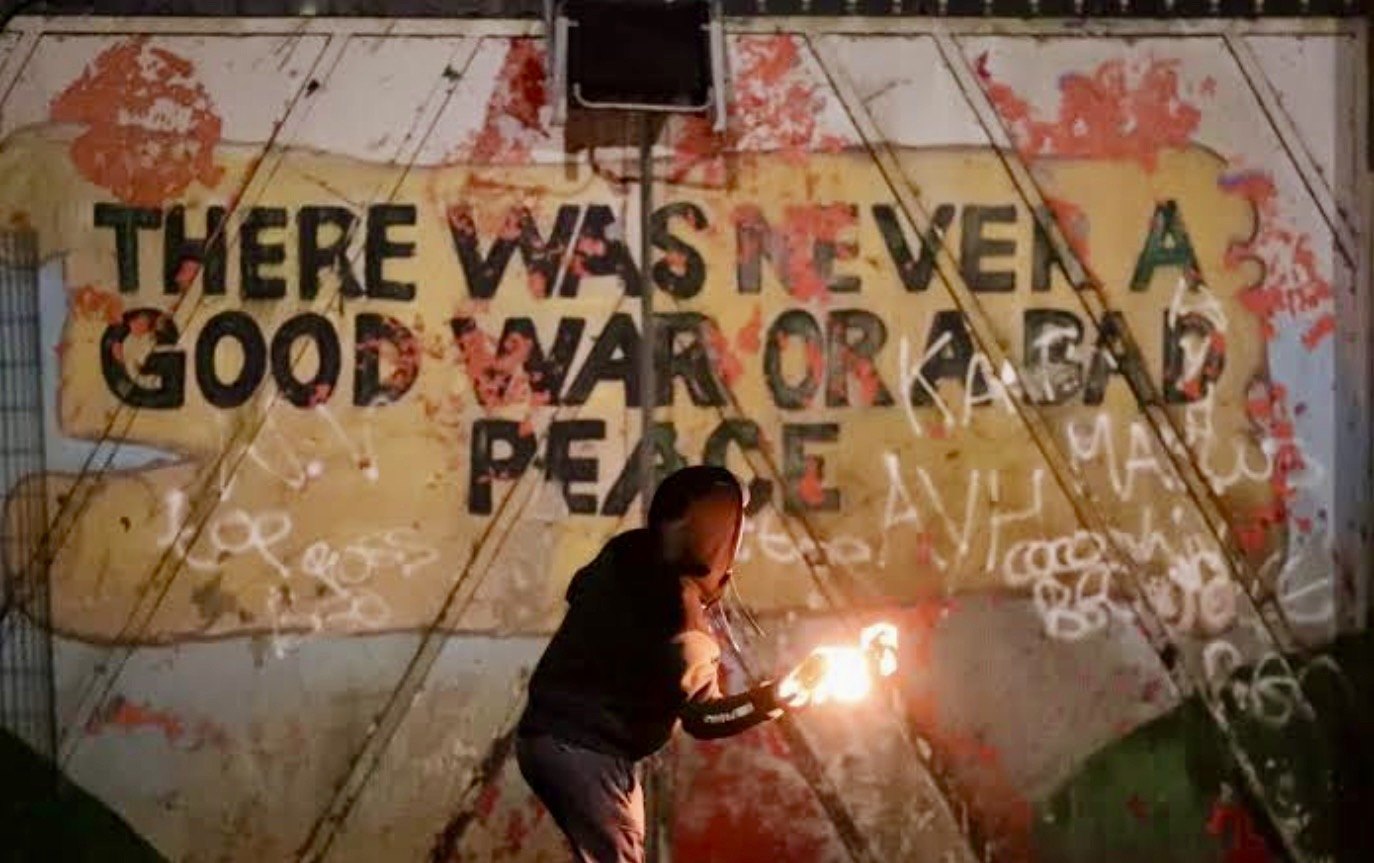
A hooded figure holds a lit petrol bomb in front of a Belfast peace-line gate painted with the words 'There was never a good war or a bad peace'
A petrol bomb at a Belfast peace line. The mural quotes Benjamin Franklin: "There was never a good war or a bad peace."

After every wave of protest, Americans on the left and right make the same complaint: the police arrest our protesters and let the other side's go free. A divided country does not turn violent because its people disagree. It turns violent when one side concludes that the state has taken the other's part and stops trusting it.

That distrust shows first on particular streets. Residents of one neighborhood stop obeying the government and govern themselves, with patrols and barricades, while people of the same community a few streets away do not. I call this contested authority: distrust turned into rival rule, and the link between what the state does and the violence that follows. My theory contends that a divided society heals when the state shows an even hand, treating like conduct alike on both sides, and opens a door, offering concessions to those shut out.

Northern Ireland lived the full arc from lost trust to recovery, and the Northern Ireland Research Initiative, which I built with Christian Davenport and Cyanne Loyle under a National Science Foundation grant, records it street by street. This project adds the police and army records that show whom the state arrested, square kilometer by square kilometer, and uses the British Army's battalion rotations, set on a roster months ahead, to compare the same streets under units that policed evenly and units that did not.

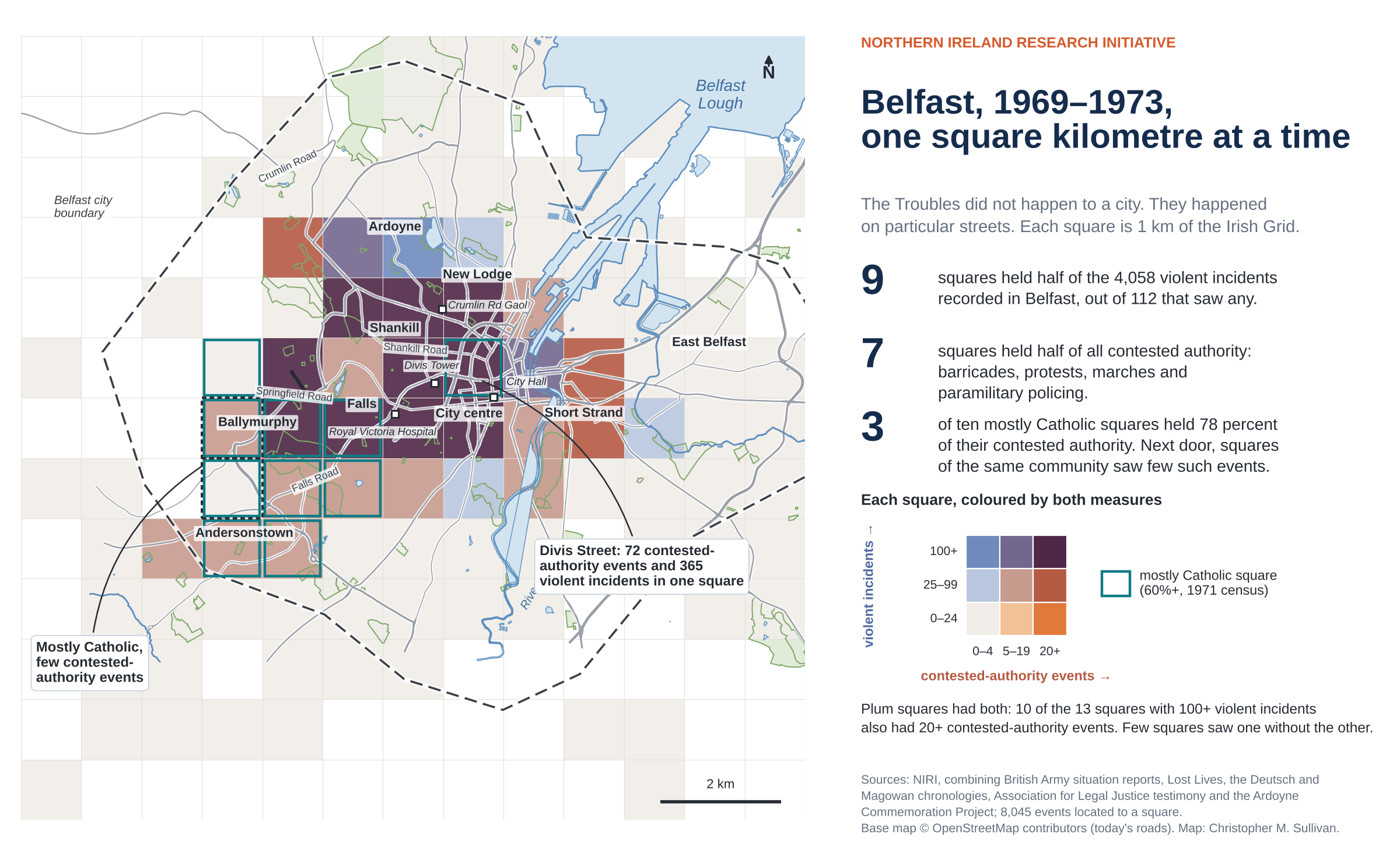
Map of Belfast on the 1 km Irish Grid, 1969 to 1973, with each square coloured by both violent incidents and contested-authority events. Nine squares held half of the city's 4,058 violent incidents, and seven held half of all contested authority. Three of ten mostly Catholic squares, around the Falls, Divis Street and Ballymurphy, held 78 percent of their contested authority, while neighbouring Catholic squares in Andersonstown saw few such events.
Belfast, 1969–1973, by square kilometre. Northern Ireland Research Initiative events located to the 1 km Irish Grid: violent incidents and contested-authority events (barricades, protests, marches, paramilitary policing). Violence and contested authority cluster on a handful of streets, and squares in the same community a few hundred metres apart diverge sharply. A first look at the atlas The Even Hand will publish. Select the map to enlarge it.

What it will tell us

Four tests ask how trust breaks, how concessions buy it back, how it returns after violence, and whether the pattern holds in U.S. counties since 2020. The findings become a book for general readers, The Even Hand; an online atlas of trust and policing in Northern Ireland; a U.S. county map of policing by conduct; and three one-page decision cards, for police chiefs, for mayors and governors, and for mediators, each stating one practice and the evidence behind it.

19601970198019902000
NIRI events data, 1968–1998
1961–65 baseline
New police and army records

Top: existing NIRI events data on the Troubles, complete and public. Bottom: new collection for this project: polarization measured before the conflict, from the 1961 census and the 1965 Stormont vote, and street-level police and army records from the escalation through the regeneration programs of the late 1980s and early 1990s.

  • Data in handNorthern Ireland Research Initiative, 1968–1998, publicly released; survey data on trust in the police since 1989
  • New collectionPublic Record Office of Northern Ireland and the PSNI, Belfast; The National Archives, Kew; two six-week trips, 2027 and 2028
  • OutputsThe book The Even Hand; an atlas; a U.S. county map; decision cards for police chiefs, mayors and governors, and mediators
  • ThemeResisting order
Book manuscript · complete

Why Not Rebel?

The Micro-Foundations of Political Order

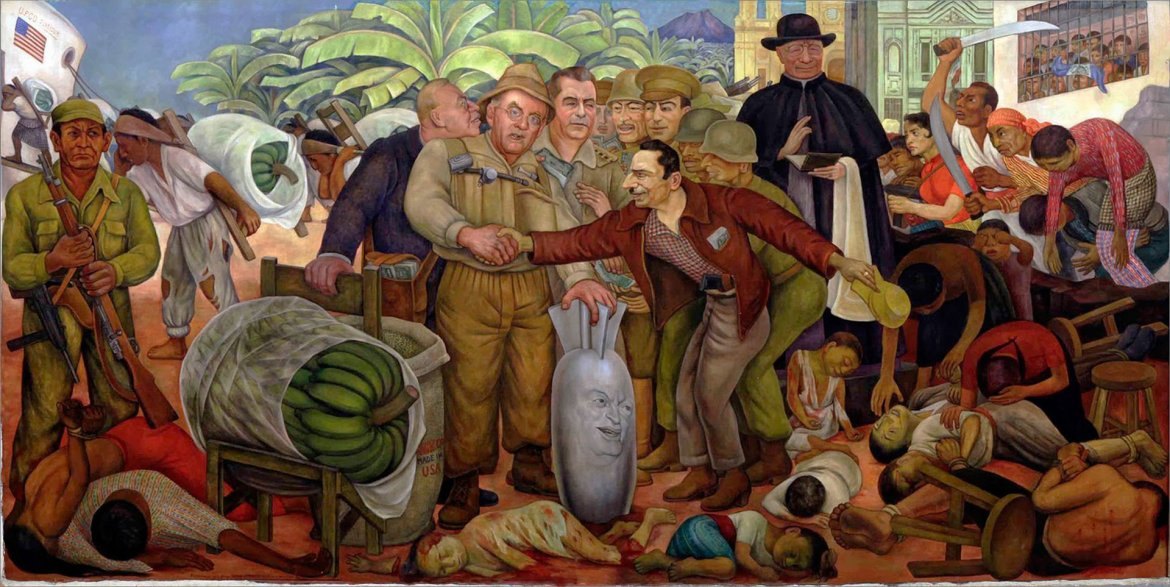
Diego Rivera's mural Gloriosa Victoria: U.S. officials and Guatemalan officers shake hands over a bomb amid bananas and the bodies of Guatemalans
Diego Rivera, Gloriosa Victoria (1954), on the coup that ended Guatemala's democratic decade and set the country on the path to civil war.Oil on canvas. Pushkin State Museum of Fine Arts, Moscow. © Banco de México Diego Rivera Frida Kahlo Museums Trust, Mexico City / Artists Rights Society (ARS), New York.

Guatemala's civil war produced one of the most extreme campaigns of state violence in the Western Hemisphere. Then the mass killing ended, years before the war formally did, and a political order took hold that most Guatemalans had not chosen and few openly resisted. Why Not Rebel? asks how.

Drawing on more than 100,000 records of the National Police that I hand-coded over two years in an archive of eighty million pages, and using the 1976 earthquake as a shock to the state's capacity to watch, the book shows that repression produces order not by containing violence but by dismantling the clandestine organizational work on which open challenge depends, and by reshaping the ideological composition of local civil society. Its later chapters follow the legacies of that repression into municipal and national elections since 1996 and into the demands of protests decades later, measured against the demands for redistribution communities made before the conflict. Rather than asking why people rebel, it asks why, so often, they do not, and finds the answer in the organizational life that repression targets rather than in the attitudes of individuals or the strength of the state alone. What we call peace, it argues, can be the successful narrowing of what communities are able to demand.

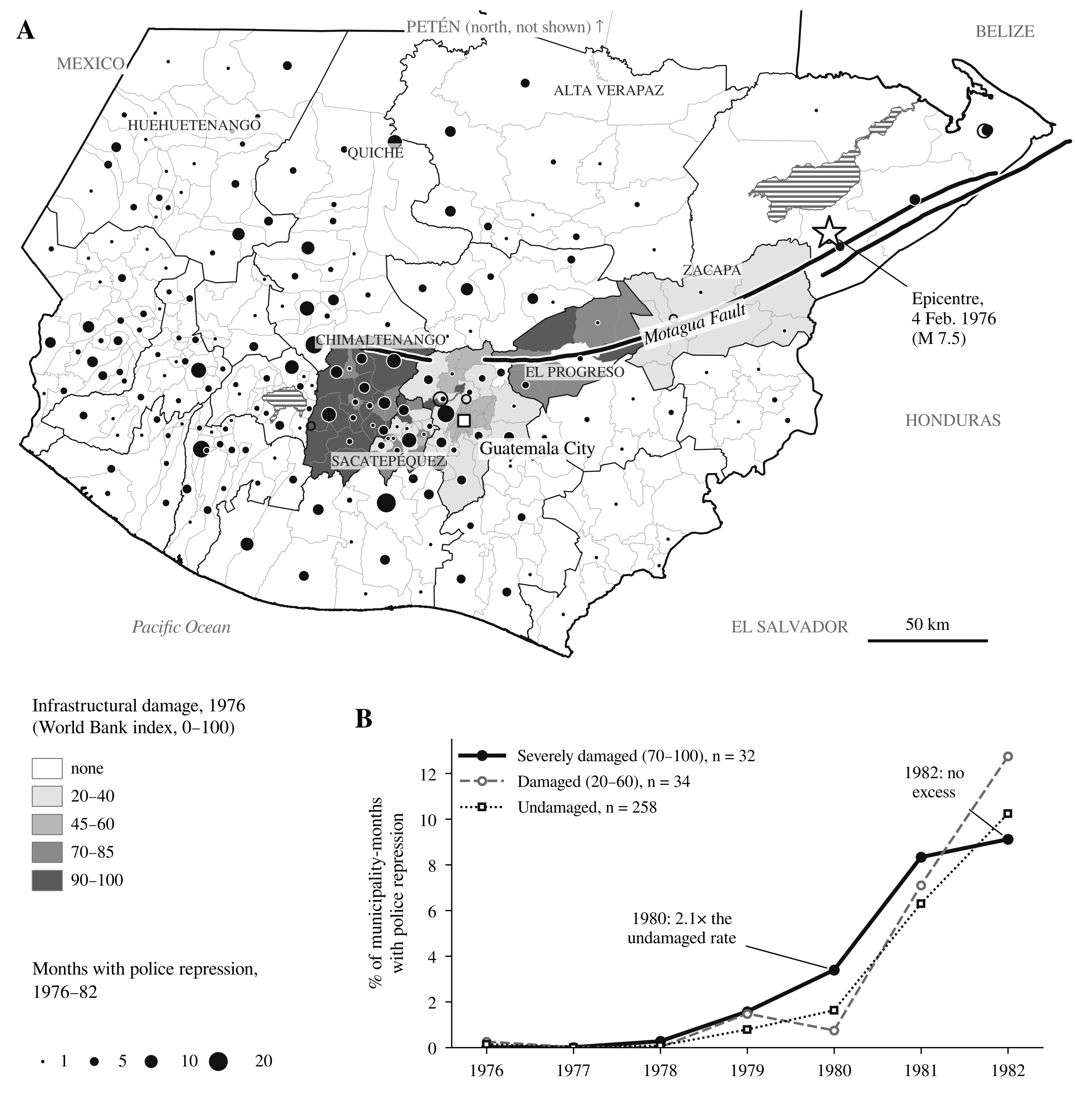
Two-panel figure. Panel A maps Guatemalan municipalities shaded by 1976 earthquake damage, concentrated along the Motagua Fault in Chimaltenango, Sacatepéquez, El Progreso and Zacapa, with circles sized by months of police repression from 1976 to 1982. Panel B plots the share of municipality-months with police repression by damage level: severely damaged municipalities rise above the others by 1980, at 2.1 times the undamaged rate, and the gap closes by 1982.
The 1976 earthquake as a natural experiment. A: infrastructural damage (World Bank index) and months with police repression, 1976–82, by municipality. B: police repression by damage level. Where the earthquake broke the state's capacity to watch, repression ran at 2.1 times the undamaged rate by 1980, before the gap closed in 1982. See "And the Heat Goes On" (JCR 2021).
  • StatusComplete manuscript, seven chapters
  • EvidenceGuatemalan National Police Historical Archive, fieldwork 2009–2011 and 2023; municipal election and protest data, 1996–present
  • SupportSSRC, National Science Foundation, Smith Richardson Foundation Strategy and Policy Fellowship
  • PresentedVanderbilt, Michigan, Stanford; Georgetown, spring 2027
Research project · data collected June 2026 · coding under way

Bureaucracy and Brutality

Intelligence and state-sponsored massacres in Iraq, 1987–1989

How the state constructs threatsSchematic of the argument. Party informants watch some villages and not others. Their reports pass up through party branches to regional intelligence, thinning as they rise. Analysts label some watched communities as threats, and violence is directed back down at those labeled villages, while unwatched villages stay invisible to the state.SecuritydirectorateRegionalintelligencePartybranchesVillagesThreat listRegionBranchBranchBranchReports thin outas they riseLabeled communitiesselected as targetsUnwatched villages stay invisible to the state
Village under party surveillanceNot watchedReports flowing upViolence directed down
1Surveillance reaches unevenlyFurther into some regions than others
2Reports filter upwardLocal information travels up the hierarchy unevenly
3Communities are labeled threatsAgencies sifting their data mark whole places
4Targets are selectedMassacres follow where the labels fall
The argument, in schematic: states construct threats, then respond to them. Surveillance reaches some communities and not others, information thins as it moves up the party hierarchy, and the communities analysts label as threats are selected for violence. The project's two linked datasets, on intelligence transfers and on massacres, measure each link. Illustrative, not data.

Why do states commit massacres where and when they do? Cross-national research has treated mass killing as a single calculus made by national agencies responding to pre-existing threats. This project argues instead that states first construct threats and then respond to them: surveillance reaches further into some regions than others, information gathered locally filters upward unevenly, and as intelligence agencies sift their data, entire communities can be labeled threats and selected as targets.

The evidence comes from the Ba'ath Party records in the Hoover Institution's Northern Iraq Database, seized by Kurdish forces in 1991 and covering the regime's most violent years. Produced for bureaucratic performance rather than public consumption, they are among the most unfiltered records of a state security apparatus available anywhere. From them I am building two linked datasets, on where and when massacres took place and on the transfer of intelligence about potential threats, with qualitative evidence of the causal process extracted from the Arabic originals. The project extends the organizational approach from the policing of dissent to the gravest form of state violence, and it ties my early work on massacres in Guatemala to the state's informational capacity.

  • EvidenceBa'ath Party records, Northern Iraq Database, Hoover Institution, Stanford
  • SupportHoover Institution Silas Palmer Fellowship, 2025–2026
  • StatusData collection completed at Hoover in June 2026; coding and analysis under way
  • ThemeEnforcing order
Public writing and media

Research in public arguments

Findings on torture, proactive policing, and humanitarian aid have been covered by the Los Angeles Times, The Daily Telegraph, Toronto Star, New York Daily News, Ars Technica, Reason, La Presse, Die Presse, Phys.org, PsyPost, Journalist's Resource, and Crime and Justice News, and discussed on KCBS San Francisco, Louisiana Radio Network, KATC, and WAFB.

Contributing writer for The Monkey Cage (Washington Post), Political Violence at a Glance, Mobilizing Ideas, AidData, Small Wars Journal, and Open Human Rights.

Essays

Data

Each collection described by where, when, unit of analysis, and source, and tagged by the theme it serves.

Six decades of the paper trail of coercion

The years each collection covers, to scale. Colors mark the research theme it serves; select a label for the collection.

Census and Stormont vote baselineNorthern Ireland · 1961–65
Police "Red Squad" and RNA recordsUnited States · 1968–71
Northern Ireland Research InitiativeNorthern Ireland · 1968–98
Association for Legal Justice testimonyNorthern Ireland · 1970s–early 1990s
National Police archive (AHPN)Guatemala · 1975–85
Municipal conflict dataGuatemala · 1977–94
Ba'ath Party recordsIraq · 1987–89
Elections and protest demandsGuatemala · 1996–present
NYPD enforcement and crimeUnited States · 2014–15
19551965197519851995200520152025
Enforcing orderResisting orderEvaluating coercionArchives as data
100,000+police records hand-coded from the Guatemalan National Police Historical Archive's eighty million pages
1968–1998thirty years of the Troubles in NIRI, from street to country, complete and public
4 countriesGuatemala, Northern Ireland, the United States, and Iraq
Resisting order

Northern Ireland Research Initiative (NIRI)

A disaggregated, multi-source events database on the Troubles, built to study the conflict–repression nexus at the level where it unfolds: the street, the neighborhood, the battalion.

Where
Northern Ireland, from street to country level
When
1968–1998
Unit
Event, with perpetrator and victim recorded
Sources
Government and security-force records, legal cases, newspapers, human rights reports, eyewitness testimony, videotaped interviews
With
Christian Davenport (Michigan) and Cyanne E. Loyle (Penn State)
Funding
National Science Foundation, 2015–2020
Status
Collection complete; publicly released through the Northern Ireland Research Initiative (niresearch.org) and the Qualitative Data Repository
Archives as data

Association for Legal Justice testimonies

Human rights testimony collected by the Association for Legal Justice, formed in 1970 to document abuses against residents of Northern Ireland during the conflict. Archived for public use as part of NIRI.

Where
Northern Ireland
When
1970s to the early 1990s
Unit
Witness statement
Access
Public, Qualitative Data Repository (version 2, 2023)
Cite as
Loyle, Davenport & Sullivan (2018), "Association for Legal Justice (ALJ) Human Rights Testimony, Northern Ireland," QDR
Enforcing order

Guatemalan National Police archive (AHPN) event data

More than 100,000 police records hand-coded over two years of fieldwork from the confidential records of the Policía Nacional, distinguishing the clandestine organizational work of dissident groups from their overt collective action, the state's responses to each, and the demands each organization made.

Where
Guatemala, subnational
When
1975–1985
Unit
Police-recorded event: acts of surveillance and repression and the dissident activities they targeted; organization-year demands
Source
Archivo Histórico de la Policía Nacional, discovered in 2005; some 80 million pages
Fieldwork
2009–2011 and 2023, supported by the SSRC and an NSF dissertation grant
Enforcing order

Guatemala legacy data

Municipal-level data on what communities demanded before the conflict and what they demand and vote for after it, used in the legacy chapters of Why Not Rebel? to trace how repression that targeted mobilization shaped the ideological distribution of civil society and support for political demands decades later.

Where
Guatemala, municipality
When
1952 baseline; 1996 to the present
Sources
Municipal and national election returns, 1996–present; political demands of protests, coded from the Social Conflict Analysis Database (SCAD); historical demands for redistribution extracted from the records of the 1952 agrarian reform (Decree 900)
Enforcing order

In construction: Ba'ath Party intelligence and massacre data, Iraq

Two linked subnational datasets built from the Ba'ath Party records in the Hoover Institution's Northern Iraq Database for Bureaucracy and Brutality: where and when massacres took place, and how intelligence about potential threats moved through the regime.

Where
Iraq, subnational
When
1987–1989
Source
Ba'ath Party records seized in 1991, Hoover Institution Library & Archives, Stanford
Status
Collection completed June 2026; coding and analysis under way; Silas Palmer Fellowship, 2025–2026
Resisting order

US police intelligence and Black nationalist records

Weekly panel data on the Republic of New Africa and the police "Red Squad" units that surveilled it, drawn from archived materials produced by both sides.

Where
United States
When
1968–1971, weekly
Unit
Organization-week: mobilization, overt repression, and covert surveillance
Sources
Police intelligence files and the organization's own records
With
Christian Davenport
Evaluating coercion

Guatemala municipal conflict data

Monthly, municipality-level data on insurgent and counterinsurgent violence, including torture, assembled from truth-commission and human rights documentation to evaluate coercive counterinsurgency.

Where
Guatemala, municipality
When
1977–1994, monthly
Unit
Municipality-month
Resisting order

In development: street-level police and army records, Northern Ireland

Records of whom the state arrested and which battalion was on the street, matched to NIRI by 1 km square and month for The Even Hand, with census, housing, election, and government records on community cohesion, political behavior, and concessions.

Where
Northern Ireland, 1 km squares
When
1961–65 baseline; the Troubles from 1969
Sources
Public Record Office of Northern Ireland; Police Service of Northern Ireland; The National Archives, Kew
Status
Two six-week field trips, summers 2027 and 2028

Publications

Peer-reviewed articles in reverse chronological order, tagged by theme. Abstract opens a plain-language summary; Cite gives BibTeX.

Peer-reviewed articles

13.

And the Heat Goes On: Police Repression and the Modalities of Power

Howard Liu and Christopher M. Sullivan

Journal of Conflict Resolution 65(10): 1657–1679, 2021

Enforcing order
JournalPDF
12.

New Findings from Conflict Archives: An Introduction and Methodological Framework

Laia Balcells and Christopher M. Sullivan

Journal of Peace Research 55(2): 137–146, 2018. Introduction to the special issue New Findings from Conflict Archives, co-edited with Laia Balcells

Archives as data
Special issue
11.

Resistance Is Mobile: Dynamics of Repression, Challenger Adaptation, and Surveillance in US "Red Squad" and Black Nationalist Archives

Christopher M. Sullivan and Christian Davenport

Journal of Peace Research 55(2): 175–189, 2018

Resisting order
Journal
10.

Activism in an Age of Mass Surveillance

Christopher M. Sullivan, in Charles Crabtree, Christian Davenport, Erica Chenoweth, Dana Moss, Jennifer Earl, Emily Hencken Ritter, and Christopher M. Sullivan, "Contentious Politics in the Trump Era"

PS: Political Science & Politics 51(1): 17–25, 2018

Resisting order
Journal
9.

Evidence that Curtailing Proactive Policing Can Reduce Major Crime

Christopher M. Sullivan and Zachary P. O'Keeffe

Nature Human Behaviour 1(10): 730–737, 2017

Evaluating coercion
JournalPDFCoverage
8.

The Rebel Alliance Strikes Back: Understanding the Politics of Backlash Mobilization

Christopher M. Sullivan and Christian Davenport

Mobilization 22(1): 39–56, 2017

Resisting order
Journal
7.

Political Repression and the Destruction of Dissident Organizations: Evidence from the Archives of the Guatemalan National Police

Christopher M. Sullivan

World Politics 68(4): 645–676, 2016

Enforcing order
Journal
6.

Undermining Resistance: Mobilization, Repression, and the Enforcement of Political Order

Christopher M. Sullivan

Journal of Conflict Resolution 60(7): 1163–1190, 2016

Enforcing order
JournalPDF
5.

Doing Harm by Doing Good: The Negative Externalities of Humanitarian Aid Provision during Civil Conflict

Reed M. Wood and Christopher M. Sullivan

Journal of Politics 77(3): 736–748, 2015

Evaluating coercion
4.

The (In)effectiveness of Torture for Combating Insurgency

Christopher M. Sullivan

Journal of Peace Research 51(3): 388–404, 2014

Evaluating coercionRunner-up, Journal of Peace Research Article of the Year Award, 2014
3.

The Northern Ireland Research Initiative: Data on the Troubles from 1968 to 1998

Cyanne E. Loyle, Christopher M. Sullivan, and Christian Davenport

Conflict Management and Peace Science 31(1): 94–106, 2014

Archives as data
JournalDataset
2.

The Coercive Weight of the Past: Temporal Dependence and the Conflict-Repression Nexus in the Northern Ireland "Troubles"

Christopher M. Sullivan, Cyanne E. Loyle, and Christian Davenport

International Interactions 38(4): 426–442, 2012

Resisting order
Journal
1.

Blood in the Village: A Local-Level Investigation of State Massacres

Christopher M. Sullivan

Conflict Management and Peace Science 29(4): 373–396, 2012

Enforcing order
Journal

Essays and other writing

Under review and in progress

Human Rights Advocacy and Repression: Subnational Evidence from Guatemala

Under review

Enforcing order

Who Rats? Political Arrests and Prisoner Defection in America

In preparation for the American Political Science Review. Declassified interrogation records of 175 arrested Black nationalists test the prisoner's dilemma empirically: vulnerability to police pressure, not ideology, predicts defection, and the structure of challenger networks limits what political arrests can extract

Resisting order

Backlash

Christopher M. Sullivan and Emily Hencken Ritter

New project on when coercion provokes resistance rather than deterring it

Resisting order

The Organizational Approach to State Repression

Christian Davenport, Cyanne E. Loyle, and Christopher M. Sullivan

Book manuscript in progress from the Northern Ireland Research Initiative: how the organization of the security forces, from brigade to battalion, and the principal–agent dynamics within the military's reporting systems shaped who was repressed, where, and how. First paper, "The Organizational Approach to State Repression: British Security Forces in Northern Ireland," in progress

Resisting order

Teaching and Advising

Seminars on human rights, political violence, and the relationship between states and the people they govern; graduate training in causal inference, data collection, and writing for publication.

Undergraduate

  • International Human Rights POLI 4040Fall 2026
  • State and Society POLI 4060
  • Political Violence
  • The Politics of Social Movement Efficacy
  • Honors Seminar in Human Rights

Graduate

  • Causal InferenceGraduate seminar on design-based causal inference, in the department's methods sequence.
  • Writing for Publication in Political Science POLI 7001Fall 2026. The graduate program's capstone seminar, built around four drafts and three rounds of peer review.
  • Domination and the Arts of Resistance
  • Anarchy, Violence, and the Rule of Law
  • Order and Inequality
  • International Human Rights

Graduate advising

  • Cana Kim Dissertation chair. Ph.D., Louisiana State University; Postdoctoral Fellow, Arizona State University.
  • Wonmin Hong Dissertation chair, in progress. Authoritarian legality: rule of law and rule by law.
  • Sanjida Mehrin Dissertation chair, in progress. Governing Under Scrutiny: Gender and the Visibility of Human Rights Abuse in Mexico.

Training students on data

Students on the Northern Ireland Research Initiative learned archival sampling and coding, event-data construction, public-records requests, and the text-extraction and machine-learning pipeline that made the data possible. Data collection is a method in its own right, and I teach it as one.

Funding and Service

Funding and fellowships

  • Louisiana State University nominee, Andrew Carnegie Fellows Program (2027 cohort), for The Even Hand 2026
  • Hoover Institution, Stanford University, Silas Palmer Fellowship, for Bureaucracy and Brutality 2025–2026
  • Smith Richardson Foundation, Strategy and Policy Fellowship, for Why Not Rebel? 2019–, extended
  • National Science Foundation, Collaborative Research: An Organizational Approach to State Repression, Co-PI, $594,903 2015–2020
  • NYU Center for Human Rights and Global Justice, Postdoctoral Research Associate 2014–2015
  • Yale Program on Order, Conflict, and Violence, Predoctoral Fellow 2013–2014
  • NSF Doctoral Dissertation Improvement Grant 2011–2012
  • SSRC International Dissertation Research Fellowship 2010–2011

Service, positions, and talks

  • Associate Professor, Louisiana State University 2021–
  • Assistant Professor, Louisiana State University 2015–2021
  • Chair, Research Committee, Department of Political Science, LSU 2024–
  • Guest editor, Journal of Peace Research special issue on conflict archives 2018
  • Managing Editor, Journal of Conflict Resolution 2008–2012
  • Invited talks at Georgetown (spring 2027), Stanford's Hoover Institution, Vanderbilt, Michigan, Yale, Duke, NYU, Uppsala, PRIO, UNC, Notre Dame, George Washington, George Mason, CUNY, and King's College London

Contact

  • csullivan@lsu.edu
  • Department of Political Science, Louisiana State University
    208-A Stubbs Hall, Baton Rouge, LA 70803